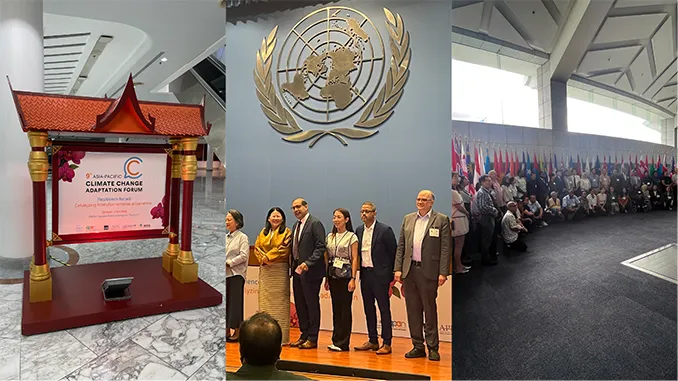

The APAN 9th Adaptation Forum was held in October 2025 in Bangkok, Thailand, co-hosted by the UN Economic and Social Commission for Asia and the Pacific (UNESCAP), the Asian Development Bank (ADB), and the Asia-Pacific Network for Global Change Research (APN).

Over the five days, speakers from the UN, NGOs/NPOs, and Government Ministries sought to share knowledge through workshops and presentations focused onpriorities critical to achieving a just and climate-resilient future for all. The key outcomes included expertise and understanding of operational transformation, adaptation, and recommendations for key approaches and strengthening partnerships (existing and new) to advance adaptation in the Asia Pacific region.
Adaptation approaches need to move from incremental to transformational
Throughout various sessions, it became clear that due to the increasing impact of climate change on agriculture, aquiculture, towns and cities, there needs to be an accelerated approach to adaptation, but it also needs to be transformational to go beyond the incremental change, requiring more community and locally led approaches to confront climate change.
There needs to be more initiatives that can quickly scale and be rolled out across regions, rather than in small-scale projects or as prototypes. Many ideas and proposals have been proven; now there needs to be a shift to transformational projects across regions, nations and continents.
The success of adaptation projects cannot always be measured
Unlike mitigation projects such as carbon reduction, carbon capture, or alternative transport, which can be measured with data, the outcomes of adaptation projects cannot be directly measured, as many co-benefits extend beyond the project’s scope and impacts. Adaptation is not a linear process, unlike mitigation, for which inputs and outputs can often be measured. Adaptation is usually a reiterative process that can take time to yield overall benefits, and it is frequently better to be approximately right rather than completely wrong.
Increased need for Climate Literacy
Many people (within governments and on the ground) lack climate literacy in the areas of the carbon cycle, weather vs. climate, critical thinking, and assessing scientific and non-scientific information. There is also a lack of recognition of the impacts of climate change that extend beyond environmental impacts into social and economic ones.
Young people need climate education and a voice
In some nations in the Asia-Pacific region, there is an increasing need to work with young people to understand their needs, as they will also inherit the adaptation projects currently being implemented. An example is Nepal, where over 45% of the population is under 25, and nearly half (49.5%) of the workforce is in the early working-age group (15-24). This underscores the need to provide climate literacy for young people so they can make informed decisions in the future and become more involved in the decision-making process.
Utilising Indigenous, Traditional, and Local Knowledge (ITLK)
When developing adaptation approaches, it is key to incorporate Indigenous, Traditional, and Local Knowledge (ITLK). The knowledge of the people who live (or lived) on the land over time can provide key insights, practices and responses that have been developed in the past or even more recently. Indigenous and Traditional knowledge is integral, but so is local people’s knowledge, as it is specific to the place where they live and provides insights into the recent past that cannot be measured through climatic data, photos or satellite information.
Also, a greater need to understand the importance of seeking permission and investing time in relationships with indigenous and local people, as consultation can often become transactional rather than formative. By investing time and effort, the likelihood of success when implementing projects increases.
Integration of Science and ITLK
Integrating science with Indigenous, Traditional, and Local Knowledge (ITLK) can benefit adaptation approaches, as local knowledge provides greater context and guides the objectives and framework for applying climate science. Science and ITLK can be used to strengthen the process and development of ideas and adaptation approaches.
Lack of knowledge sharing and outcomes
There are many governments and non-profit organisations undertaking adaptation projects (solar power, mangrove and reef restoration, floating wetlands, resilient crops, warning systems (heat/flood), however, there is a lack of knowledge sharing of approaches and outcomes. This is often due to the number of organisations and people involved in adaptation and climate change initiatives. There is a need for greater knowledge sharing among NGOs, Universities, and governments to ensure that investments achieve the best outcomes for the local environment and community.
Increasing Local-Led Adaptation
Adaptation efforts should involve balanced decision-making, including greater involvement of local governments and people. This would also increase the scalability of local-led adaptation, which can be quickly rolled out as it reduces time spent on education and on securing local support for the adaptation efforts, since they have already been consulted during decision-making.
Also, the employment of local people to undertake adaptation projects is essential to the success of these projects. Adaptation is a medium and long-term process that requires stewardship from local people. Contractors and outside parties often lack long-term vision and are frequently only there for the short construction period and initial maintenance.
More local partners are required
International and National NGO’s require more local partners to build capacity and knowledge for the implementation of adaptation initiatives. Often, the NGO’s have the funds and expertise; however, they lack capacity and therefore require local partners. Also, as countries increase their commitments and pledges through National Adaptation Plans (NAP), they also rely on NGO’s and local partners to execute the required initiatives to meet the plans’ (NAP) objectives.
Greater need for finance standards and instruments
The funds available from various sources (ADB, World Bank, National Governments), however, there are several issues:
- The funding is insufficient to cover the commitments under the Paris Agreement.
- The investment in blue or green bonds often requires a return on investment or outcomes that are hard to measure in adaptation projects.
- Assessment and compliance standards vary across nations and investment organisations.
- Limited resources (people) to assess the proposals received (either at a national or investment organisation level).
- Adaptation Proposals often lack design or technical information and/or allocation for monitoring and assessment (due to a lack of knowledge, consultants, or understanding of the process).
- Proposals often lean towards grey infrastructure as it is known and easier to cost.
- One size (approach) does not work for all nations or contexts.
Due to these issues and the lack of standards, it is often challenging to assess proposals and allocate funding to achieve the most significant benefits for adaptation projects. More consistent standards are required for evaluating and financing projects, as well as greater alignment among governments, banks, and agencies to derisk funding initiatives and improve project knowledge and success.
Disaster Management and Mitigation funding are disproportionate
When a cyclone or disease outbreak hits, governments often reallocate emergency funds to address short-term crises. This is frequently due to the immediate need to address short-term problems rather than the need to invest in medium- to long-term issues. This is also exacerbated by the short-term nature of government terms (3-4 years), during which political pressure outweighs the area’s or nation’s broader needs.
Also, mitigation efforts such as power transition (alternative energy), electric vehicle rebates, and environmental subsidies account for the majority of climate financing. This is because financiers can more easily fund mitigation initiatives, as they can see immediate returns and measurable data on mitigation efforts; however, adaptation funding offers a greater return on investment, such as reducing impacts and damage to coastal settlements from rising sea levels and storm events. There is a need to balance funding for mitigation and adaptation efforts to ensure the best outcomes.
Cooperation between the bordering nations
Adaptation efforts often rely on coming to agreements with surrounding nations, as climate change impacts do not stop at geopolitical boundaries. Therefore, there is a greater need than ever to increase cooperation between countries to determine priorities and allocate resources to improve the chances of success of National Adaptation Plans.
How can landscape architects get involved?
I attended several events (held by the UN and other organisations) during Climate Action Week in Bangkok, including the 9th APAN forum. What struck me was that there were few landscape architects in attendance. I think the first step landscape architects can take is to attend events, especially those with workshops, to input our knowledge and understanding from a landscape perspective.
There is a need for landscape architects to be involved in adaptation projects and to attend these events to meet with NGO/NPOs on the ground implementing adaptation initiatives. Landscape architects have the experience and knowledge to bring local people together and to manage a broad range of consultants and expertise to achieve desired outcomes.
Landscape architects need to push for greater post-occupancy evaluations and project reviews to assess and demonstrate that adaptation projects achieve outcomes. The lack of data and information about adaptation stems from limited availability and its context-specific nature. If landscape architects could provide more data and knowledge on adaptation, this would provide information that could lead to increased financing and political will to implement National Adaptation Plans (NAPs).
More lobbying of governments (national, regional and local) and the private sector (banks, insurance companies, etc.) is required to increase funding for adaptation efforts (green infrastructure, stormwater management, coastal rehabilitation). Currently, governments and financiers’ focus on mitigation lacks an understanding that climate mitigation requires significant mental and cultural changes that will go well beyond the crisis points we face, whereas adaptation can make physical changes to reduce the impacts of climate change in the short, medium, and long term.
Landscape architects need to design for adaptation by integrating multi-functional performance into a project. Whether including rain gardens with performative soil that encourages lush, biodiverse planting, along with interpretative signage for education. Alternatively, selecting light coloured permeable paving that reduces the heat island effect whilst reducing runoff volumes into stormwater systems and associated waterways.
There are many ways landscape architects can become involved in adaptation efforts. I think the most powerful is to attend events outside the landscape industry that involve NGOs and other organisations, where we can assist in achieving their goals and objectives.
Article by Damian Holmes, Founder & Editor of World Landscape Architecture